
Linus Torvalds Launches AudioNoise: The Rise of Vibe Coding

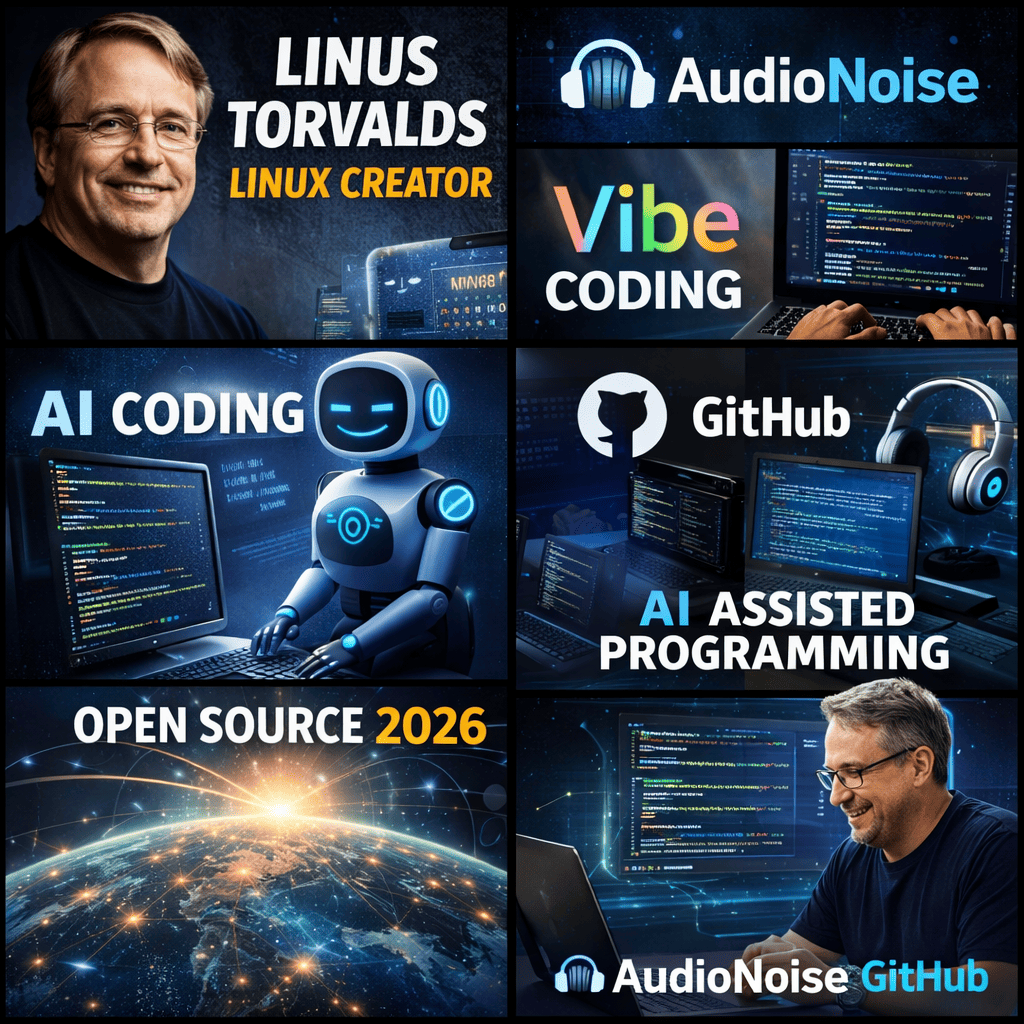
Linus Torvalds’ Latest Project "AudioNoise" is Here—And Yes, He’s "Vibe Coding" Now!
If you had told me a few years ago that Linus Torvalds—the legendary, often blunt creator of Linux and Git—would be using AI to help write code, I would have laughed. Linus is the ultimate "purist." He’s the guy who reviews every line of the Linux kernel with a metaphorical magnifying glass.
But it’s 2026, and the world has changed. Linus recently unveiled a new, small-scale open-source project called AudioNoise. But the headline isn't just the software itself; it's the fact that he openly admitted to using Vibe Coding to bring it to life.
As a developer who has followed Linus for years, I found this move both shocking and deeply encouraging. Let’s break down what this project is and why this shift in his workflow is a massive deal for all of us.
What is AudioNoise?
At its core, AudioNoise is a specialized tool designed to generate high-quality, customizable background noise (white noise, pink noise, etc.) directly through the system’s audio architecture. While it might sound simple, the implementation—as you’d expect from Linus—is lean, efficient, and written to interact deeply with hardware.
It isn't a massive operating system, but it’s a perfect example of a "weekend project" that solves a specific problem with precision. You can check out the source code on Linus Torvalds' GitHub (though he usually keeps his main work on kernel.org).
Wait, What is "Vibe Coding"?
For those who haven't heard the term, Vibe Coding is the 2026 evolution of AI-assisted programming. It’s a workflow where the developer focuses on the "vibe"—the high-level logic, the architectural flow, and the intent—while an AI (like an advanced Cursor or a specialized LLM) handles the heavy lifting of syntax and boilerplate.
In his own words (via recent mailing list discussions), Linus noted that he didn't want to spend hours looking up obscure audio header documentation. Instead, he described the "vibe" of how the audio buffers should behave, and the AI generated the implementation. He then refined, audited, and polished the output.
Why This Matters (The "Linus Seal of Approval")
When the most respected figure in open-source history embraces AI tools, it marks the end of the "AI vs. Real Coders" debate.
- Efficiency Over Ego: Linus has always been about "what works best." If AI can generate a clean audio buffer implementation in 5 seconds that would take him 30 minutes to look up, he sees it as a logical tool, not a threat.
- The "Auditor" Role: This project shows the future of our jobs. We are moving from being "writers" to being "editors." Linus didn't just copy-paste; he used his decades of experience to ensure the AI's "vibe" met his rigorous standards for performance and safety.
- Accessibility: If Linus is doing it, it gives permission to every junior developer to use AI—as long as they remain critical of the output.
The Human Element: My Personal Take
I find it incredibly humanizing to see Linus working on something like AudioNoise. It reminds us that at the end of the day, even the world's most famous programmer just wants to build cool things that work.
The fact that he’s using modern AI tools shows he isn't stuck in the past. He’s evolving. It’s a lesson for all of us: the tech stack doesn't matter as much as the solution. If "Vibe Coding" helps the creator of Linux get a project done faster, imagine what it can do for your next "impossible" idea.
Final Thoughts
AudioNoise is a tiny project compared to the Linux kernel, but its significance is huge. It represents the "Vibe Coding" era's official arrival. If you haven't tried building something with AI lately, maybe it's time to take a leaf out of Linus's book.
What do you think? Is "Vibe Coding" the future, or are we losing the "soul" of programming? Let’s chat in the comments!
Would you like me to find the specific GitHub link for the project or explain how to set up a "Vibe Coding" environment like the one Linus might be using?