
Republic Day of India 2026: History, Significance and Constitution

Republic Day of India 2026: History, Significance and Constitution
Republic Day of India, celebrated every year on 26 January, marks one of the most important milestones in the nation’s history. On this day in 1950, India officially became a sovereign democratic republic with the enforcement of the Indian Constitution. Republic Day is not just a national holiday; it is a powerful reminder of democracy, equality, justice, and the rule of law.
While India gained independence on 15 August 1947, the country continued to function under the Government of India Act, 1935. It was only after adopting its own constitution that India truly became a nation governed by its people.
Historical Background of 26 January
The date 26 January holds deep historical significance. On 26 January 1930, the Indian National Congress declared Purna Swaraj (Complete Independence) from British rule. To honor this historic resolution, the same date was chosen for the enforcement of the Constitution in 1950.
After nearly three years of drafting, debates, and revisions, the Constitution of India came into effect, transforming the country into a republic where the head of state is elected, not inherited.
The Indian Constitution and Its Architect
The Constitution of India is the longest written constitution in the world. It took 2 years, 11 months, and 18 days to complete and reflects the values of democracy, secularism, and social justice.
The drafting committee was led by
Dr. B. R. Ambedkar, who is widely regarded as the chief architect of the Indian Constitution.
Key Features of the Constitution:
- Fundamental Rights
- Fundamental Duties
- Equality before law
- Freedom of speech and expression
- Right to religion
- Independent judiciary
Republic Day reminds every citizen that the Constitution is supreme and that power ultimately lies with the people of India.
Significance of Republic Day in Modern India
Republic Day symbolizes:
- The transition from colonial rule to self-governance
- The strength of Indian democracy
- Unity in diversity
- Respect for constitutional values
It reinforces the idea that India is governed by laws, not individuals, and that every citizen is equal regardless of caste, religion, gender, or region.
Republic Day Parade at Kartavya Path
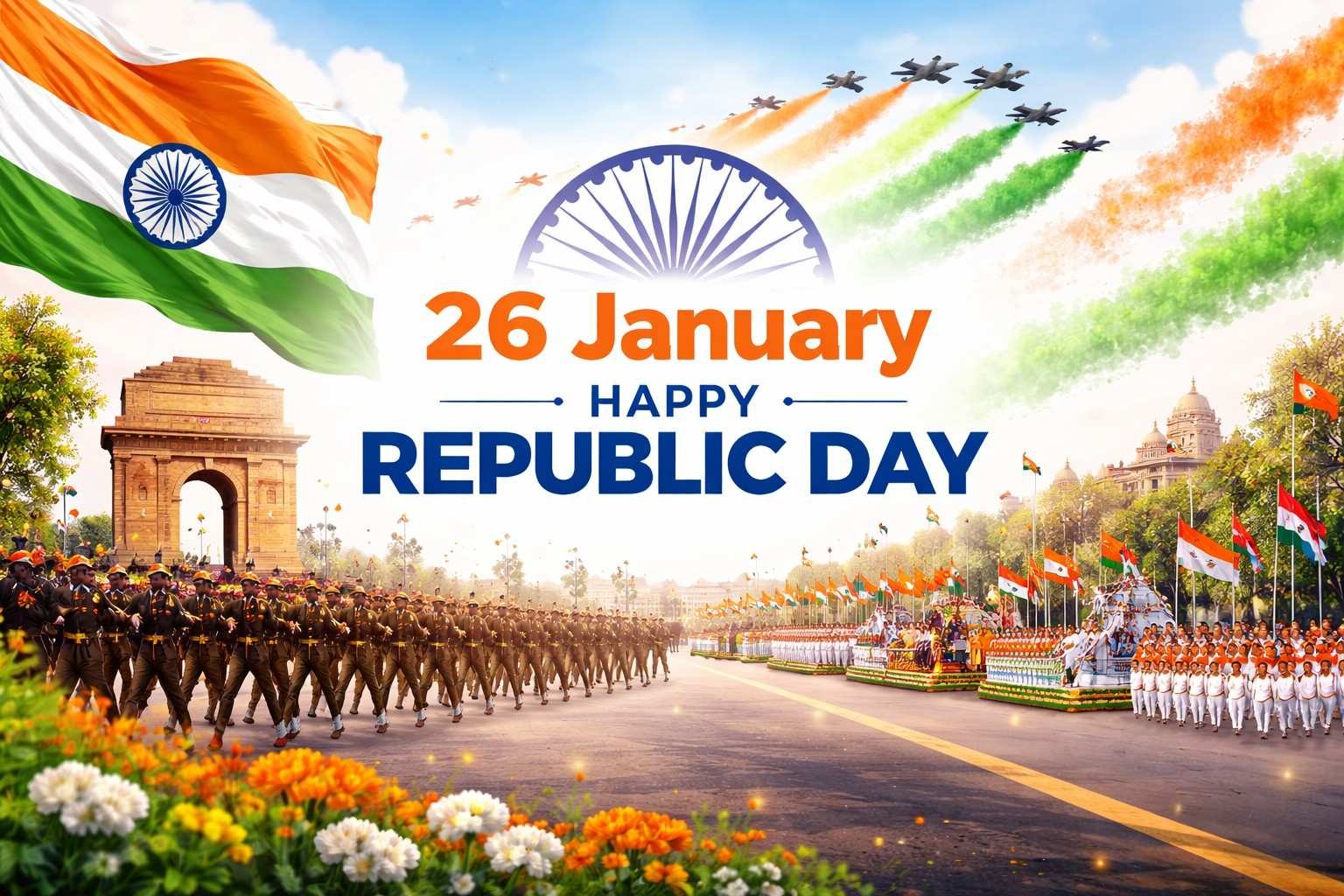
One of the biggest highlights of Republic Day is the grand parade held at Kartavya Path, New Delhi. The parade is a spectacular display of India’s military strength, cultural diversity, and technological progress.
- Major Attractions of the Parade:
- Marching contingents of the Indian Army, Navy, and Air Force
- Indigenous missiles and defense equipment
- Colorful state tableaux showcasing Indian culture
- Performances by school children
- Fly-past by Indian Air Force fighter jets
The parade reflects India’s balance between tradition and modernity and attracts global attention every year.
Chief Guest and Global Diplomacy
A unique tradition of Republic Day is inviting a foreign head of state or government as the Chief Guest. This reflects India’s strong diplomatic ties and growing influence on the global stage.
The presence of a global leader highlights India’s role as a responsible democratic power in international affairs.
National Awards Announced on Republic Day
Republic Day is also the occasion when the Government of India announces prestigious civilian and gallantry awards.
Major Awards Include:
- Padma Vibhushan
- Padma Bhushan
- Padma Shri
- Ashoka Chakra
- Kirti Chakra
- Shaurya Chakra
These honors recognize individuals who have made exceptional contributions to nation-building, bravery, science, arts, sports, and social service.
How Republic Day Is Celebrated Across India
In Schools and Colleges:
- Flag hoisting ceremonies
- Patriotic speeches
- Cultural programs
- Essay and debate competitions
- In Government Institutions:
- Official celebrations
- Live telecast of the parade
- Constitutional oath ceremonies
Among Citizens:
Display of the Indian tricolor
Patriotic songs and messages
Digital celebrations on social media
Message of Republic Day
Republic Day teaches us that:
- Rights come with responsibilities
- Democracy survives through participation
- Unity is India’s greatest strength
- Respecting the Constitution is true patriotism
True nationalism lies in upholding constitutional values, respecting diversity, and contributing positively to society.
Conclusion
Republic Day of India (26 January) is more than a ceremonial celebration—it is the soul of Indian democracy. It reminds citizens of the sacrifices made for freedom and the responsibility of preserving democratic values.
As India continues to grow as a global power, Republic Day stands as a symbol of constitutional supremacy, equality, and national pride.
Happy Republic Day! Jai Hind!
Discussion (0)
Join the conversation.
Sign In to CommentNo comments yet. Be the first to start the discussion.