
LPG Crisis 2026: Hormuz Strait Conflict Triggers Gas Shortage in India, 25-Day Cylinder Booking Rule Explained

LPG Crisis 2026: Hormuz Strait Conflict Triggers Gas Shortage in India, 25-Day Cylinder Booking Rule Explained
When the Stove Goes Cold... Something Big Is Already Happening
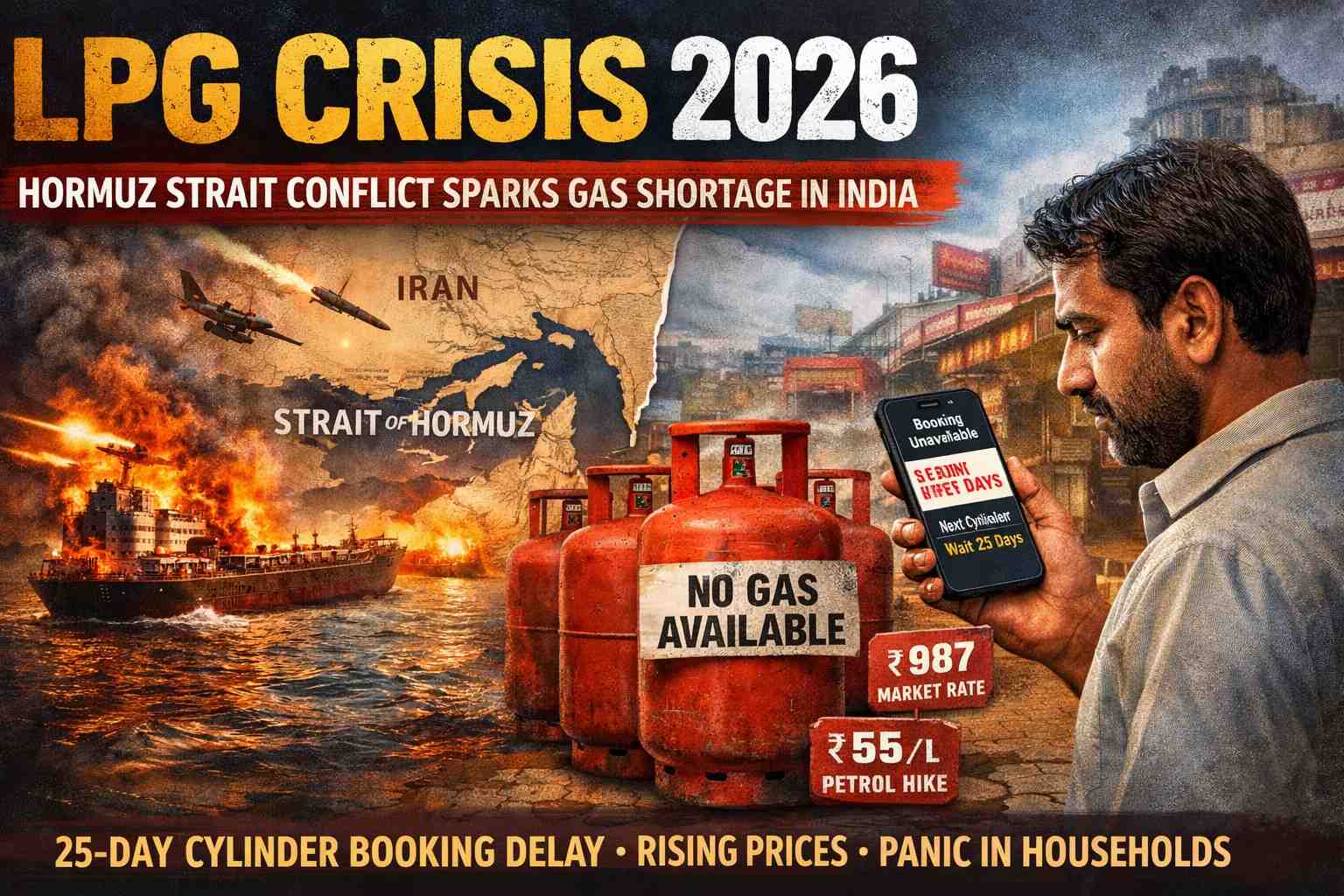
This morning, when Ravi bhai tried to book his LPG cylinder, the app told him — "Please wait 25 days for your next booking." He thought it was a glitch. But it wasn't. It was the local imprint of a global crisis.
Where Did This Maze Begin?
The story starts at the Strait of Hormuz — a place that looks tiny on a world map, but through which over 20% of the world's crude oil, natural gas, and LPG passes. On February 28, 2026, when US and Israeli forces struck Iran, Iran bit back — it practically shut down the Strait for tanker traffic.
And the moment that Strait closed, everything began to fall like dominoes. Shipping companies started cancelling voyages. Insurance firms hiked war-risk premiums by up to 1,000%. Tanker routes were diverted. And countries like India — which imports nearly 65-67% of its LPG needs, 90% of which comes through Hormuz — had only one question on their lips: "What now?"
What Is Happening to India's Kitchen?
In Mumbai, a small dhaba owner named Suresh Kaka has had no commercial cylinder since Sunday. His tiny eatery, which used to serve food in three shifts, is now running on just one. In Delhi's Connaught Place, a famous chole bhature shop put up a sign: "No gas today, chole bhature unavailable." The JNU hostel canteen shut down snacks — only tea is being served. IRCTC has told train catering units to switch to induction and microwave.
The story at home is no different. The government has enforced a new rule — after booking one cylinder, you must wait 25 days before booking again. Earlier the limit was 21 days. This rule came in because people started panic-booking from both connections simultaneously, crashing the system.
In Bengaluru, auto-rickshaw drivers running on CNG/LPG are in a bad spot — fuel jumped ₹10 per litre in just two days. In Kolkata, restaurants trimmed their menus and some switched to wood-fired cooking. Hotels in Ajmer started hunting for coal and firewood.
What's Happening in the Rest of the World?
This is not just India's crisis. It is a global crisis, wearing a different face in every country.
🇵🇰 Pakistan:
Pakistan had only 30 days of oil reserves. The result? Petrol and diesel shot up by ₹55 per litre. The government imposed COVID-style restrictions — government vehicles running at 50% capacity, offices down to a four-day week, universities shut, and Eid holidays declared early just to save fuel.
🇧🇩 Bangladesh:
Bangladesh launched energy rationing. Schools closed early, power cuts intensified, and industries were asked to cap their production.
🇱🇰 Sri Lanka:
In Sri Lanka, LPG prices climbed to ₹1,242 per cylinder — with potential for more hikes. Panic buying for fuel broke out across the country.
🌍 Nepal and Neighbours:
Nepal's LPG touched ₹1,207. One neighbouring country shut down all its universities; another pulled 60% of government vehicles off the road. The ripple from Hormuz didn't stop at the Middle East — it was felt from Asia to Europe, Africa to the Americas.
What Did the Government Do?
The government has taken both immediate and long-term steps. The Essential Commodities Act was invoked. Refineries were ordered to boost LPG production by 25-28%. Domestic cylinders were given priority over commercial supply — meaning homes and hospitals first, dhabas and restaurants second.
Petroleum Minister Hardeep Puri told Parliament there is no shortage, only panic. That same day, an IEA report stated that Gulf LPG exports of 1.5 million barrels per day had practically stopped and India was among the most affected nations. Both statements can be simultaneously true — the minister was speaking about the steps being taken, while the IEA was describing the impact that was already in motion.
PM Modi at the NXT Summit 2026 said that India's ethanol programme had cut 4.5 crore barrels of oil imports, saving ₹1.5 lakh crore. Crude oil purchases from Russia continue. A fresh LPG import contract worth 2.2 million tonnes was signed with the US Gulf Coast. The government maintains that India has a 74-day strategic reserve and imports crude from over 40 countries.
So Will It Get Even More Expensive?
Brent crude has crossed $100 per barrel. That directly means India's import bill will rise. The Saudi Contract Price for LPG went up 41% between July 2023 and March 2026. But the government has held the non-PMUY consumer price at ₹913 per cylinder while the market rate hovers around ₹987 — meaning oil marketing companies are absorbing the loss to keep your stove burning.
If the Hormuz situation stays this way for another month, expect significant price hikes in commercial cylinder rates. Restaurants and dhabas — already operating on thin margins — will be pushed to the edge. NRAI chief Sagar Daryani put it plainly: 90% of restaurants run on LPG, and if the supply doesn't come back, job losses and closures are inevitable.
What Can You Do Right Now?
A few practical things worth knowing:
1. Book your cylinder now — there's a 25-day wait, so plan ahead.
2. Induction cooktops — already out of stock in many places, so move fast if your budget allows.
3. Plan smarter meals — cook larger portions in a pressure cooker in one go.
4. Do NOT panic-book — it worsens the crisis and delays supply to others.
5. Never buy from the black market — it's illegal, and the pressure risk on those cylinders is real.
One Last Thing
This crisis is a reminder of just how global we are — a fire lit in one strait in the Middle East, and the stoves in our homes start going cold. This isn't just an energy crisis; it's a mirror held up to our dependencies, our import structure, and our future.
The government is acting. But the real question is — will we keep depending on a single route to fuel our kitchens, or will this crisis become the starting point for a new India's energy independence? Induction cooktops sold out overnight — maybe it's time to make some permanent switches.
Do share your thoughts in the comments. And yes — don't delay that cylinder booking.
Disclaimer:
This website publishes content for general informational and educational purposes only. All articles are based on publicly available information, reports, and sources at the time of publishing. The publisher does not make any warranties or representations regarding the accuracy, completeness, reliability, or timeliness of the information. Content related to news, sports, entertainment, finance, technology, automobiles, jobs, or any other category should not be considered as official, legal, financial, medical, or professional advice. Readers are advised to verify information independently before taking any action.
Discussion (0)
Join the conversation.
Sign In to CommentNo comments yet. Be the first to start the discussion.